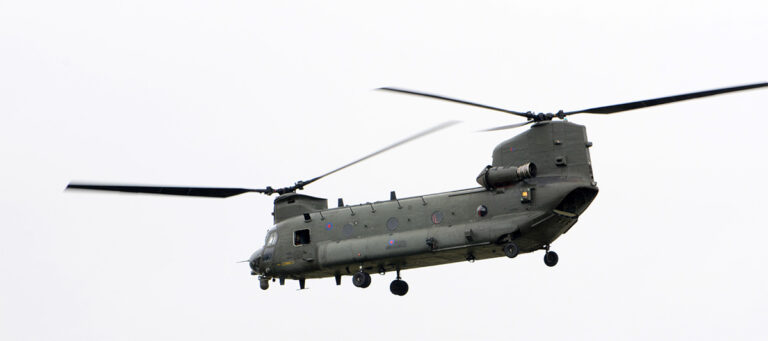
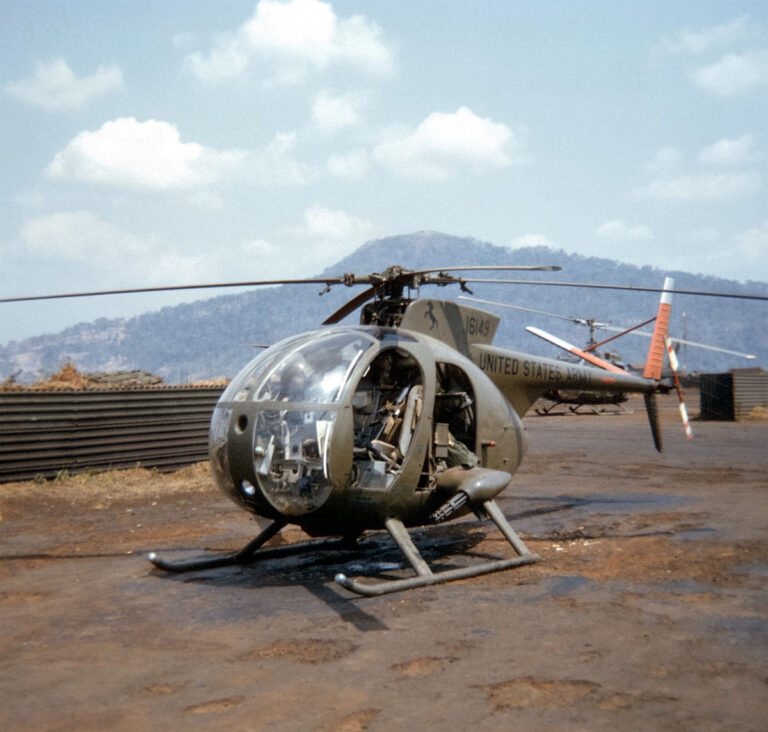
Boeing Apache Helicopter in Flight

History of the Boeing AH-64 Apache Helicopter

The Boeing AH-64 Apache Helicopter is a hallmark in the history of military aviation. Born out of a need for an advanced attack helicopter, the Apache has proven itself repeatedly. This article explores the history, features, deployment, and evolution of this remarkable helicopter.

Early Development

In the 1970s, Hughes originally designed the AH-64 Apache to meet an Army requirement. Yet, production only began in 1982. Deployment came in 1986, and 824 AH-64As became the Army’s primary attack helicopter.

Weapons and Transportation

The Apache’s quick reaction in close combat sets it apart. Equipped with the AGM-114A Hellfire anti-armor laser-guided missile, it can carry sixteen of these. Additionally, the Apache wields unguided 2.75-inch rockets and a 30mm M230 Chain Gun. Transportable in the C-5, C-141, and C-17 airplanes, it is still highly mobile.

An Illustrated History of Military Helicopters

An Illustrated History of Military Helicopters

A complete history of Army and Navy helicopters from the first visionaries to unmanned aircraft systems. This book, with over 200 helicopter photographs documents every generation of rotorcraft from early prototypes to the specialist helicopters of today.

Amazing text. As a Veteran helicopter mechanic I am passionate about all birds and their histories. Highly recommend this book. It sits firmly on my coffee table to spread the allure to friends and visitors alike. – John J.

Performance in Operation Desert Storm

In 1991, the Apache deployed extensively during Operation Desert Storm. Critics were proven wrong about its low performance. Achieving a readiness rate of 90%, it earned the nickname “Black Death” from the Iraqis. By war’s end, the Apache destroyed over five hundred tanks and hundreds of other vehicles.

Other Operations and AH-64D Longbow Apache
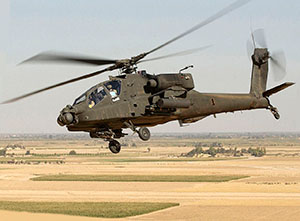
Boeing AH-64 Longbow Assault Helicopter

Besides Desert Storm, the Apache also played roles in the peace efforts in Yugoslavia and Bosnia, and the second Gulf War. A significant improvement came with the AH-64D Longbow Apache, featuring a millimeter-wave fire control radar and other enhancements. This model proved 400% more lethal and 720% more survivable than its predecessor.

From Boeing: Production and Features

Between 1984 and 1997, Boeing produced 937 AH-64As for various countries. Its high-performance engines, laser and infrared systems, and arsenal of weapons made it combat-proven.

Apache Longbow Enhancements

The radar-equipped AH-64D Apache Longbow brought further improvements. Its longer-range weapons accuracy and all-weather/night fighting capabilities added new dimensions. The integrated sensors, networking, and digital communications ensured real-time combat management and digital transmission of vital information.

Conclusion

The AH-64 Apache helicopter has evolved since its start through regular technology insertions. It continues to meet the needs of the warfighter today and promises to remain a crucial asset in the future.

Similar Posts

  • Medevac Helicopters in the Middle East

    Helicopters have proven themselves time and again in every scenario they have been exposed to. One of the areas they have particular excelled at is medevac and casevac.  Helicopters can and will go where other aircraft cannot and where ambulances can’t reach to rescue the wounded. They provide fast, smooth transportation of casualties to field hospitals many miles from the front lines and offer the ability to begin critical care as soon as they enter the airframe.

    During the two Iraq wars and while in Afghanistan, helicopters have continued their service to troops on the front lines. Soldiers and commanders depend on them, they regard them as essential and combat operations are not planned unless medevac choppers are available if needed. Such is the importance place on them in modern warfare.

  • The Kamov Ka-50 Odyssey: Russia’s Helicopter Revolution in the Skies

    Discover the unparalleled legacy of the Kamov Ka-50, a true marvel in the world of military aviation. Affectionately known as the ‘Black Shark’, this Russian combat helicopter has shaped the course of aerial warfare with its revolutionary design and unmatched capabilities. The article delves deep into the Kamov Ka-50’s rich historical roots, outlining its emergence as a game-changer in the skies. Learn about its innovative technical specifications, which set it apart from contemporaries and paved the way for future rotorcraft innovations. Explore the tactical roles it has masterfully executed, and the modern upgrades that ensure its relevance in today’s dynamic combat scenarios. Beyond the battlefield, witness the Kamov Ka-50’s cultural imprint, from video games to silver screens. This comprehensive exploration offers insights into not just an aircraft, but a symbol of Russian ingenuity and a testament to human engineering prowess.

  • |

    Boeing Chinook Helicopter Performance Video

    This video demonstrates the multiple uses of the Chinook CH-47 Helicopter.  The Chinook may look like a lumbering giant, but this video will change your opinion of the Chinook Dual-Rotor Helicopter.  The CH-47 goes through some powerful moves and you quickly realize that even the Chinook pilots get to have some serious fun with their machines.

  • History of the Hughes OH-6 Cayuse Helicopter

    The inception of the OH-6 Cayuse traces back to the U.S. Army LOH (Light Observation Helicopter) competition in 1963. From its initial identity as the Hughes Model 369, it contended against 12 other designs. The spotlight ultimately centered on three: Hughes’ Model 369, Fairchild-Hillier’s H23 Raven, and Bell’s early OH-58 Kiowa model.

    While Bell’s offering fell short due to its underwhelming power, the Hughes Model 369 – rebranded YOH-6A with a robust 252hp Allison T63-A-5A engine – soared during the trials at Fort Rucker, Alabama in 1963.

  • |

    The Huey Helicopter as a Medevac in Vietnam

    Helicopters were instrumental in the Vietnam War. The challenging terrain made land travel difficult. Moreover, long distances involved complicated things further. However, helicopters, particularly the Huey, changed the game. This article will explore how the Huey Helicopter became a crucial part of Medevac missions in Vietnam.

  • More CH-47 Chinook Helicopter History

    The Boeing CH-47 Chinook Helicopter has a storied history. Initially developed as an expansion of the Vertol Model 107, it was favored by the Army. Why? Because of its substantial carrying capacity. Its prototype took to the skies on September 21, 1961, and the Army welcomed the CH-47A Chinook in 1972.

    These large twin rotors, combined with a roomy fuselage and cutting-edge turboshaft engines, provided a level of airlift ability previously unseen. Furthermore, the design of the Chinook’s fuselage is primarily free from obstructions, housing the engine and gearbox in pylons and fuel in side pods.