Bell UH-1 Huey Helicopter
|

The Bell UH-1 Huey Helicopter

The Development of the Bell Huey Helicopter

In 1952 the US Army specified a requirement for new helicopter to serve as a medical evacuation, helicopter trainer, troop transport and general utility helicopter. Of the twenty companies that submitted designs, Bell Helicopter won the bid in late 1953 to build the first 3 prototypes based on their Model 204 design. The first flight of the XH-40 was October 20th, 1956 at Fort Worth, Texas and Bell was commissioned to build the first 100 HU-1A helicopters in March 1960, officially named Iroquois. While its official name is rarely used, the helicopter was nicknamed the Huey and the name stuck even after the US Army changed its designation to UH-1 “Huey” Helicopter.
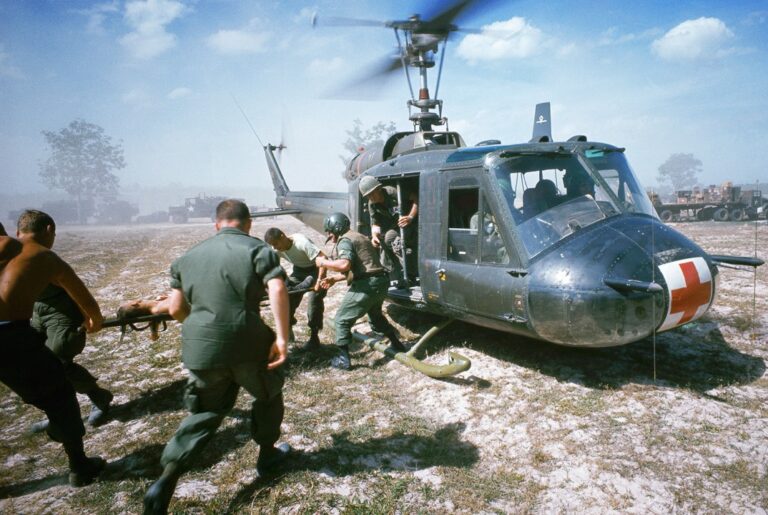
Bell Huey Helicopter in flight Soldiers exiting UH1 Huey Helicopter in Vietnam War
Bell Huey Helicopter in flight Soldiers evacuating on a UH1 Huey Helicopter in Vietnam War

Development started on the Huey Helicopter in 1960 to correct problems in the armed version of the UH-1B. Improvements included a more powerful T53-L-11 1,100 shp (820 kW) turbine engine, a new rotor system for higher airspeed and better maneuverability, longer main blades, longer tail boom, a stronger vertical fin, larger synchronized elevators and its oversized air cleaner behind the main shaft. Production of the UH-1C started in June 1966. Made famous during the Vietnam conflict, the Huey was the first helicopter gunship that achieved widespread combat use, while its main role was a troop transport. Modern versions of the Huey are expected to remain in US military service through 2015.

The Huey in Vietnam: Bell’s UH-1 at War

The Huey in Vietnam

Few implements of war are as representative of the US presence in Vietnam as the Bell Huey UH-1-series helicopters. Whether serving in the role of troop transport for airborne assault, supply transports, aerial gunships, or medical evacuation, the Huey was seemingly everywhere. The versatile aircraft, officially the “Iroquois,” was affectionately known to all as the “Huey,” a name derived from its early model designation of HU-1A. The Huey, later re-designated UH-1, was a mainstay during America’s presence in Vietnam, and 11 Huey crewmen earned the Medal of Honor.

Bell’s “Huey” Helicopter, officially known as the Model 204, formed the basis for one of the most successful series of helicopters ever built.  Flown for the first time in October 1956, it was designated the XH-40, then HU-1 by the US Army (who called it the Huey), before a designation change to the HU-1A Iroquois.  The HU-1B introduced a more powerful engine and the HU-1C had a new rotor system.  Later still the HU- designation was changed to UH-.

The turbine engine was one of the keys to the helicopter’s success. Mounted on the cabin roof just behind the gearbox, it left the cabin unencumbered and provided the performance required by the US Army.  The engine was upgraded to a 1100HP engine that became standard.  The larger engine allowed for the to be armed with rocket pods and machine guns carried on the cabin’s sides.

The UH-1C, which flew in 1965, used a new rotor system with ‘door hinges’ and wider blades.  This provided more lift, enabling the fuel load to be increased and improving the machine’s maneuverability and speed.  Variants of the UH-1C were used by the US Air Force, Navy and Marine Corps in the training, rescue and assault roles.

Bell UH-1C “Huey” Helicopter

 
Type:Single-engine multi-role utility helicopter
Poweplant:one 1100-hp Lycoming T53 turboshaft engine
Maximum Speed:148mph (238 km/h) at sea level
Initial Climb Rate:1400 fpm (427 m/min)
Range:381 miles (515 km) with auxiliary fuel
Service Ceiling:11,500ft (3505 m)
Weights:5060 lbs (2300 kg) empty; Maximum Takeoff 9480 lbs (4309 kg)
Dimensions:Rotor Diameter:  44ft (13.41 m) Length:   42ft 7in (12.98 m) Height:  12ft 7in (3.84 m) Rotor Disc Area: 1520 sq ft (141.26 m2)

Similar Posts

  • Eurocopter Tiger Helicopter Unveiled: Beyond the Battlefield

    Dive deep into the world of the Eurocopter Tiger Helicopter, a premier combat aircraft, renowned for its advanced capabilities and dynamic operational performance. This article unfolds the rich history and developmental journey of this cutting-edge helicopter, offering a detailed insight into its distinctive features and specifications. Users will appreciate learning about the various models and variants, as well as the diverse user nations leveraging the Tiger for their defense needs.
    The Eurocopter Tiger stands out for its economic impact and is pivotal in shaping aerial combat strategies, excelling in safety and reliability. Explore upcoming upgrades and future models that showcase the potential of this helicopter in evolving combat scenarios. Learn about its future developments and the significant role it is poised to play in next-generation warfare. Whether you’re an aviation enthusiast, a professional in the field, or simply curious, this comprehensive guide provides a wealth of information, engaging insights, and answers to frequently asked questions about the Eurocopter Tiger Helicopter. Don’t miss out on discovering how this remarkable aircraft is redefining the boundaries of aerial combat!

  • |

    Helicopter Dustoffs in Vietnam

    Medevac helicopters revolutionized how wounded soldiers were treated in battle. 29% of all wounded US Soldiers died during World War II. This number was reduced to 26% during the Korean War due to advances in medical technology and the use of medevac helicopters like the Bell 47. This number was further reduced to 19% during the Vietnam War. To put the percentages in to perspective, medevac helicopters in Vietnam transported 400,000 wounded soldiers compared to 17,700 during the Korean War.

  • |

    The Huey Helicopter as a Medevac in Vietnam

    Helicopters were instrumental in the Vietnam War. The challenging terrain made land travel difficult. Moreover, long distances involved complicated things further. However, helicopters, particularly the Huey, changed the game. This article will explore how the Huey Helicopter became a crucial part of Medevac missions in Vietnam.

  • US Military Helicopters in Focus

    In the intricate theatre of modern warfare, the US military’s approach to conflict has evolved significantly, particularly within the rugged desert terrains of the Middle East. Central to this evolution are military helicopters, which have seamlessly transitioned from supporting roles to becoming linchpins in war strategy. These formidable flying machines have increasingly been used for vital attack and reconnaissance missions.

    Furthermore, the modern battlescape demands constant adaptation. Consequently, the US military is continuously in pursuit of advanced helicopter designs, encompassing cutting-edge technology to better equip them for their multifaceted roles on the battlefield.

  • Sikorsky S-60 Helicopter – The Army’s Ultimate Tactical Transport System

    The Sikorsky Model S-60 was proposed to meet the Army’s need for a Utility Tacticla Transport Aircraft System (UTTAS) to replace the UH-1 Iroquois.  The prototype was first flown on October 17, 1974, and the Army ordered 2,260 of the type, designated UH-60 Black Hawk, although budgetary constraints confined the order to 1,400, the first entering service in June 1979.  The Black Hawk is considerably larger than the UH-1 and initial aircraft could carry 20 troops compared with 11, plus a substantial underslung load (8,000lbs).