Huey Powerplants Varied From Lycoming T53s to Twin-Engine T400s
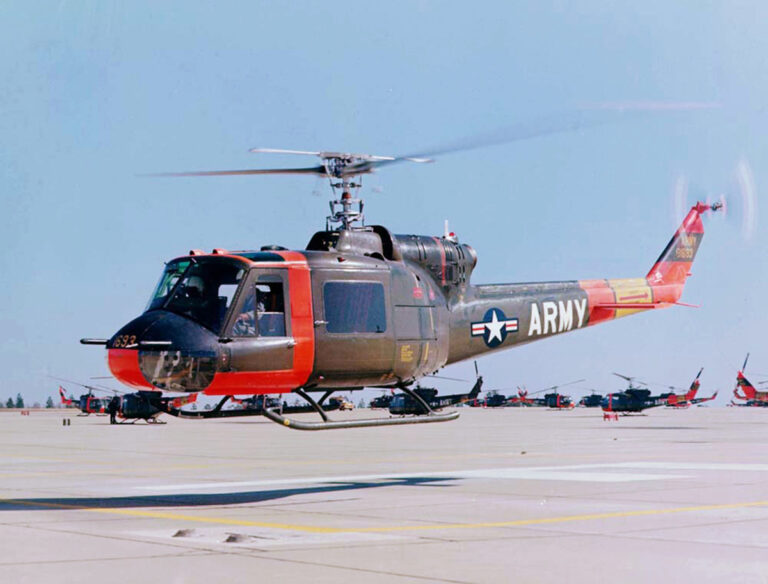
The Bell UH-1 Iroquois family is closely associated with the Lycoming T53 turboshaft, but the engine history is more varied than a single powerplant story. Early Army UH-1A aircraft used the T53-L-1A, rated at 860 shaft horsepower, while later UH-1B and UH-1C variants received higher-rated T53 models.
The long-cabin UH-1D initially used the T53-L-11. The UH-1H introduced the T53-L-13, rated at 1,400 shaft horsepower, giving the utility helicopter substantially better lifting performance in demanding conditions. Army historical material also identifies the T53-L-13B in the UH-1M upgrade and links the T53 family to both Huey and Cobra operations.
Not every aircraft bearing the Huey name used a Lycoming engine. The U.S. Air Force’s UH-1F employed a General Electric T58-GE-3 turboshaft. The later twin-engine UH-1N, a military Bell 212 derivative, used two Pratt & Whitney T400-CP-400 turboshaft engines. These distinctions matter when discussing the broad Huey lineage rather than only the Vietnam-era Army UH-1H.
Why it matters
The Huey’s familiar airframe evolved through changing payload, mission and safety requirements, and its propulsion choices reflect that development. Separating the T53-powered single-engine models from T58- and T400-powered variants provides a more accurate basis for understanding performance, maintenance and fleet history.
Sources: U.S. Army Redstone Arsenal Historical Information; U.S. Army ODIN UH-1 Iroquois reference; 20th Air Force UH-1N Huey fact sheet; SlashGear source article